
Letter a: Uniquely linked
"It is uniquely linked to the signatory."
Every signer receives their own signing link. The signature belongs to exactly this link and exactly this person.
Advanced electronic signature
AES uniquely links a signature to one person and makes later changes to the document detectable. With SmartDocs, a six-digit code by SMS is all it takes: no app, no account, done in seconds.
The advanced electronic signature is the middle of the three levels defined by the eIDAS Regulation. It is uniquely linked to one person, is capable of identifying them, is created under their sole control and makes later changes detectable. It suits every contract with no form requirement where proof matters more than usual.
The EU eIDAS Regulation distinguishes three levels of electronic signature. The simple signature (SES) documents that something was signed. The advanced signature (AES) also proves who signed: it is firmly bound to one person and to the document exactly as it was signed.
The qualified signature (QES) goes one step further and replaces the statutory written form. It requires identity verification by a trust service provider. AES does without that effort, which is why it is the level that most often makes the difference in day-to-day business.
Simple signature
Signing link by email
Advanced signature
Signing link plus SMS code
Qualified signature
Verified identity and qualified certificate
Art. 26 eIDAS
What makes a signature advanced is set out in Art. 26 of the eIDAS Regulation. The letters show where each requirement becomes visible in a SmartDocs request.
"It is uniquely linked to the signatory."
Every signer receives their own signing link. The signature belongs to exactly this link and exactly this person.
"It is capable of identifying the signatory."
Name, email address and mobile number are recorded with the signature and appear on the completion certificate, with the number shortened to its last digits.
Employment contract
Page 3 of 3
Mara Schulz
aSigned by Mara Schulz
m.schulz@example.com, +49 ••• •••• 4711
bDocument SHA-256: 9f2c81d05b7e…a3c7e41a
d"It is created using electronic signature creation data that the signatory can, with a high level of confidence, use under his sole control."
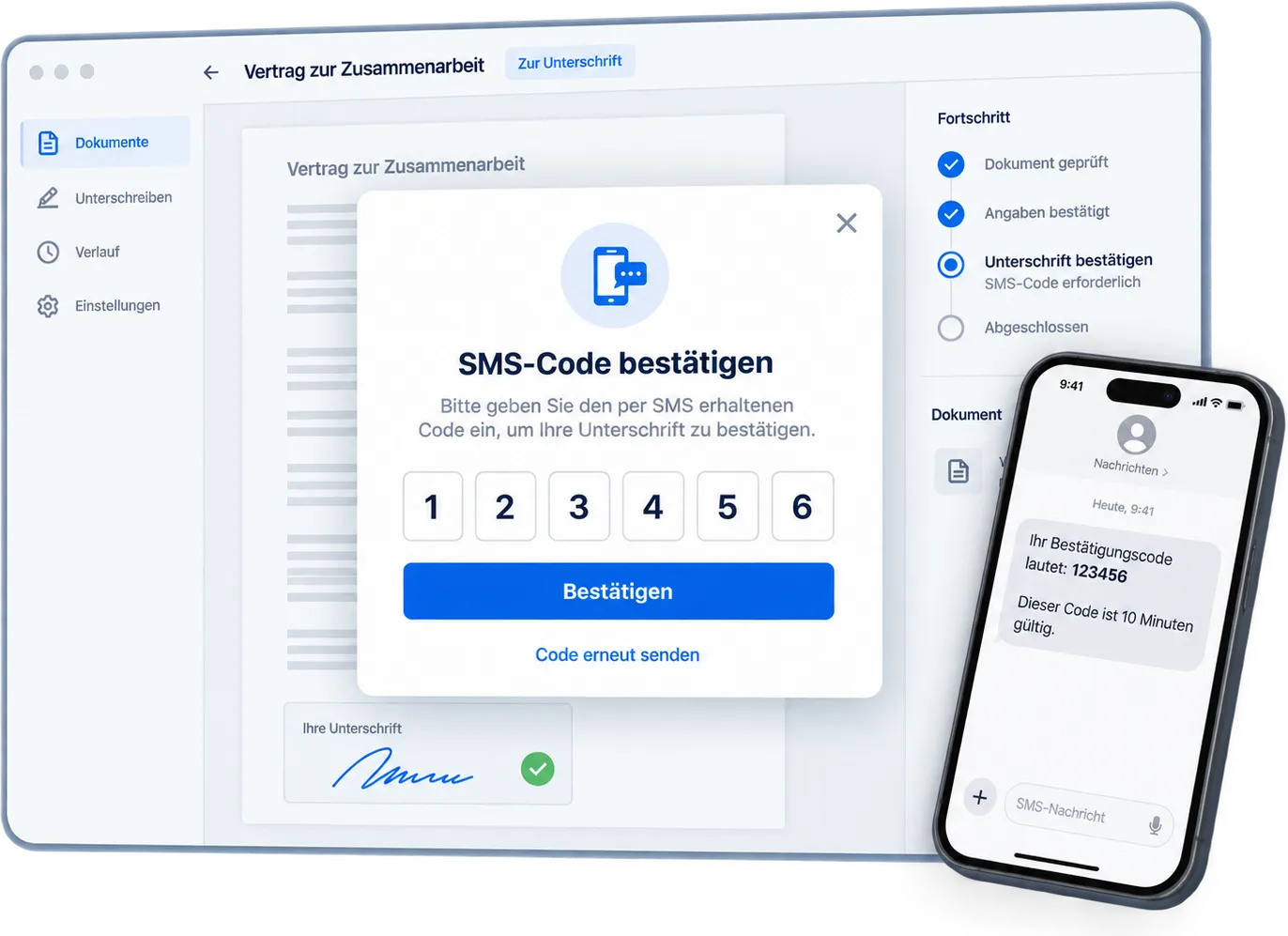
Signing is only completed with the six-digit code that only the signer's mobile phone receives. It is valid for 10 minutes, and a new code invalidates the old one.
"It is linked to the data signed therewith in such a way that any subsequent change in the data is detectable."
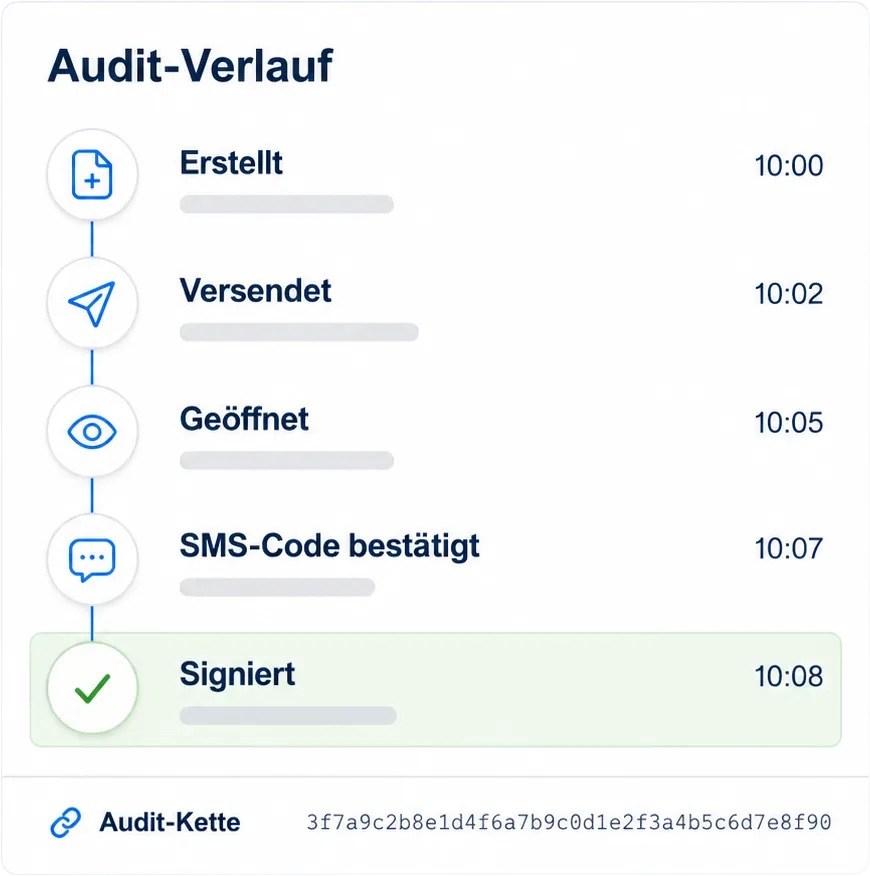
The SHA-256 hash of the final document appears on the completion certificate, and every event is part of the audit trail's hash chain. If a single byte changes, the hash no longer matches.
Evidential value
No electronic signature may be denied admissibility as evidence solely because it is electronic (Art. 25 (1) eIDAS). A statutory presumption of authenticity, however, exists only for QES (§ 371a ZPO, German Code of Civil Procedure). With AES, the court evaluates the evidence freely (§ 286 ZPO).
This is exactly where AES plays to its strength. If someone disputes the signature, you have more than an email address: the confirmed SMS code shows that the signer's mobile phone was involved, with a timestamp in the audit trail.
Use cases
AES is the right choice when a contract has no form requirement but involves a lot of money, a long term or a possible dispute.
| Document | Why AES | Learn more |
|---|---|---|
| Permanent employment contract | No form requirement, but a strong interest in proof over many years. | Employment contract guide |
| Residential lease | No form requirement if open-ended. AES proves who entered into the lease. | Lease guide |
| Brokerage agreement | For apartments and single-family homes, text form is enough (§ 656a BGB, German Civil Code). AES adds extra protection for the commission claim. | For real estate agents |
| Vehicle purchase agreement | Large sums and warranty questions: unique attribution pays off. | For car dealerships |
| Maintenance and framework agreement | Ongoing obligations over years, often with automatic renewal. | For the trades |
| Banquet and conference contract | Large sums and tiered cancellation fees, where proof is what counts. | For hotels |
| Amendment with a written form clause | For written form agreed by contract, electronic transmission is sufficient unless the parties intended otherwise (§ 127 (2) BGB). | On legal validity |
Limits
For most contracts, AES is more than enough. There are two cases you should know about before you start a request.
If the law requires written form, only the qualified signature meets that form electronically (§ 126a BGB). The most important cases:
Some documents require notarization or expressly exclude the electronic form. No signature level helps here.
Comparison
Identification, evidential value and written form: the three levels side by side.
| SES Simple electronic signature | AES Advanced electronic signature | QES Qualified electronic signature | |
|---|---|---|---|
| Identification | No separate identity verification required | Linked to the signer's mobile phone number | Identity verification by a qualified trust service provider |
| Authentication | Personal signing link sent by email | One-time code by SMS (OTP) on top of the signing link | Qualified certificate issued to the verified identity |
| Evidential value | Admissible as evidence in court (Art. 25 eIDAS) | High evidential value through unique attribution (Art. 26 eIDAS) | Meets the electronic form (§ 126a BGB), with a presumption of authenticity in court |
| Typical documents |
|
|
|
| Available | From Free | From Pro | On request |
| Statutory written form (§ 126a BGB) | No | No | Yes, met |
For details and examples, see Signature levels compared.
How it works
For you, it is a setting when you create the request. For the other party, it is a code that takes a few seconds.
Upload a document or choose a template, set the level to AES and enter the signer's mobile number.
The signer opens the document in the browser, with no app and no account, and adds their signature.
SmartDocs sends a six-digit code to the number you entered. Once it is entered, the signature is complete and recorded in the audit trail.
Costs
No pricing on request, no bundles: AES is included from the Pro plan, with SMS included per seat.
Pro
€25
per seat per month
15 SMS per seat per month included
Enterprise
€40
per seat per month
30 SMS per seat per month included
Each SMS beyond the included quota costs €0.15. An AES signature usually sends one SMS; if someone requests a new code, that one counts too. AES is not included in the Free plan. All prices plus VAT, cancel monthly.
A team with 3 seats on the Pro plan has 60 contracts signed with AES in one month, each by one signer.
plus VAT
Decision guide
Choose your document and instantly see the form requirement, the minimum level and our recommendation.
Which document do you want to have signed?
Choose a document
The level finder shows the form requirement, the legal minimum level and our recommendation, with the legal basis.
Frequently searched
Guidance, not legal advice for your individual case. When in doubt, choose the higher level.
FAQ
Start for free and switch to Pro as soon as you need AES: €25 per seat per month, 15 SMS per seat included, cancel monthly.