Qualified electronic signature (QES): as binding as your handwritten signature
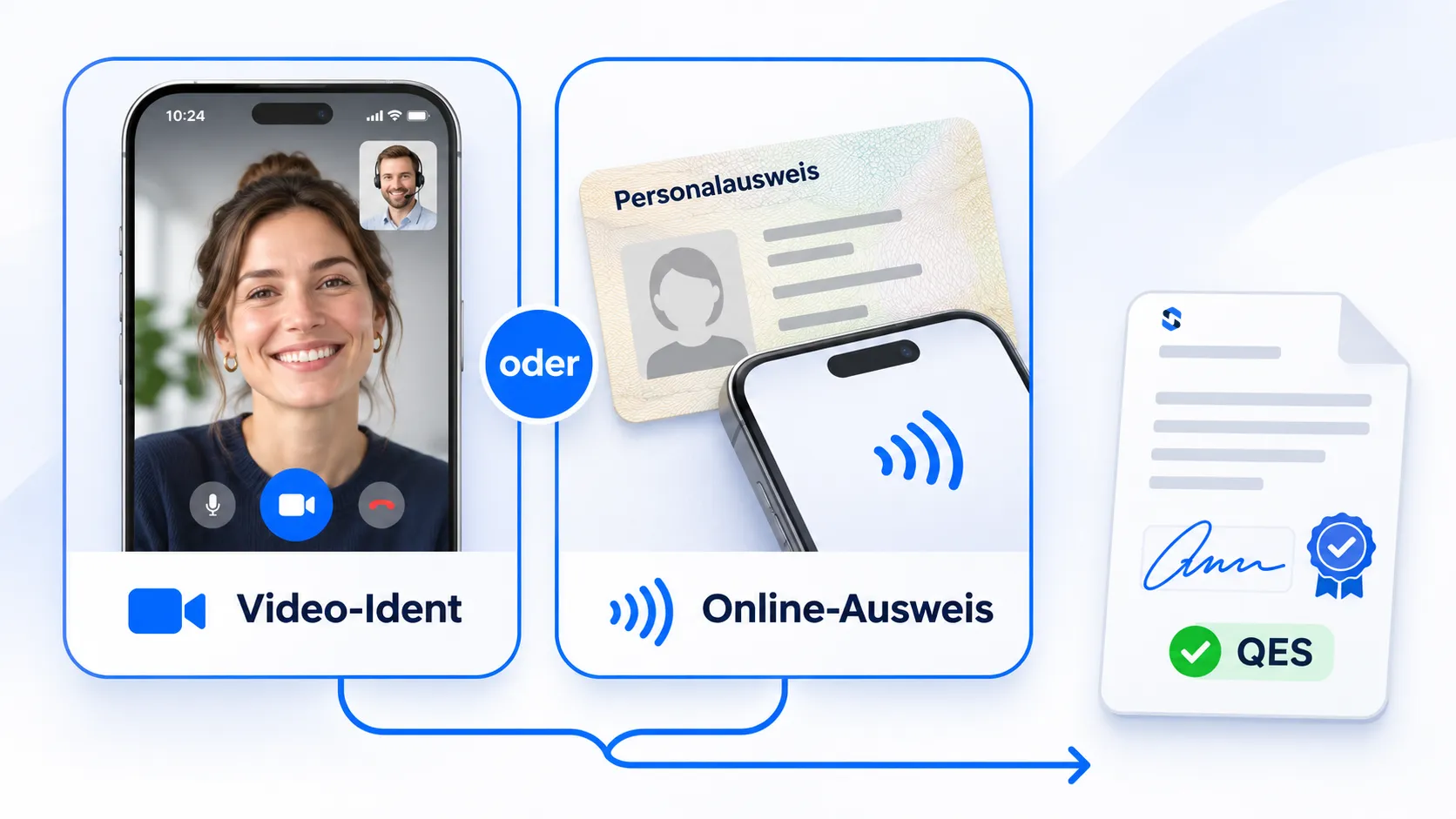
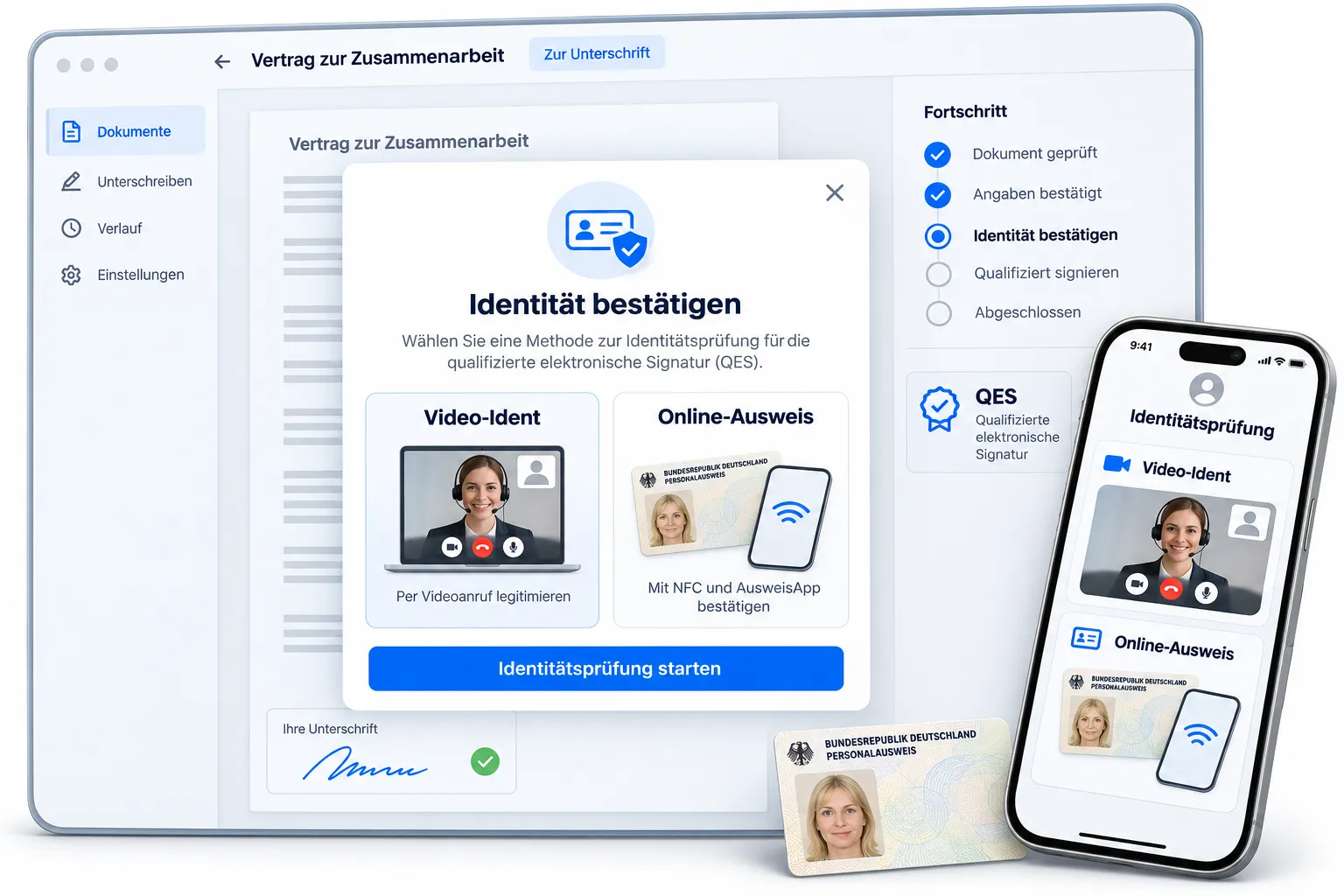
The QES is the highest level of electronic signature under eIDAS and the only one that replaces the statutory written form. With SmartDocs, you use the QES in the same workflow as all your other signatures: confirm your identity once by video ident or online ID, then sign with a qualified signature.
The highest level of electronic signature. An advanced signature that is based on a qualified certificate and created with a qualified signature creation device (Art. 3 (12) eIDAS).
What does it do?
Legally equal to a handwritten signature, across the EU (Art. 25 (2) and (3) eIDAS). In Germany, it replaces the statutory written form (§ 126a BGB).
When is it required?
When the law requires the statutory written form and allows the electronic form, for example for the fixed term of an employment contract or a real estate loan.
How is it created?
Identify once by video ident or online ID, then simply approve each signature, usually as a remote signature without a card reader.
What does it cost?
At SmartDocs, on request. The QES is billed per signature; volume and identification method determine the price.
The eIDAS Regulation builds the QES from three components. If one is missing, the signature is advanced at most.
1
Advanced signature
Uniquely linked to the signer, and any later change to the document becomes detectable.
Art. 26 eIDAS
+
2
Qualified certificate
Confirms the verified identity of the signer. Only a qualified trust service provider may issue it.
Art. 3 (15), Art. 28 eIDAS
+
3
Qualified signature creation device
Certified, secured hardware that holds the signing key. For remote signatures, the trust service provider operates it.
Art. 3 (23), Art. 29 eIDAS
=
QES
Same legal effect as a handwritten signature.
Art. 3 (12), Art. 25 (2) eIDAS
Qualified trust service providers are listed on the EU Trusted List and, in Germany, supervised by the Federal Network Agency (Bundesnetzagentur). Only a natural person can create a QES; for organizations, there is the qualified electronic seal.
Legal effect
What makes the QES legally special
Equal by law
The QES has the same legal effect as a handwritten signature.
Art. 25 (2) eIDAS
Replaces the written form
Where German law requires the statutory written form and does not exclude the electronic form, a QES is enough. For contracts, both parties sign an identical document with a qualified signature.
§ 126 (3), § 126a BGB
Presumption of authenticity
In court, authenticity is presumed. The presumption can only be rebutted by facts that give rise to serious doubt. In practice, this reverses the burden of proof.
§ 371a (1) ZPO
Recognized across the EU
A QES based on a qualified certificate from one member state is recognized as a QES in all other member states.
Art. 25 (3) eIDAS
When it is mandatory
When is a QES required?
If the law requires the statutory written form and allows the electronic form, the QES is the only digital option. Leaving it out costs more than a formality:
Document
Legal basis
Consequence without the written form
Fixed term in an employment contract
§ 14 (4) TzBfG
The employment is deemed permanent (§ 16 TzBfG).
Residential lease with a fixed term of more than one year
§ 550 BGB
The lease counts as open-ended.
Termination of a residential lease
§ 568 (1) BGB
The notice is invalid (§ 125 BGB).
Real estate consumer credit agreement
§ 492 (1) BGB
The agreement is void in principle (§ 494 (1) BGB).
Employment reference in electronic form
§ 109 (3) GewO
Electronic only with the employee’s consent, otherwise on paper.
General consumer credit agreements need the statutory written form, meaning paper or a QES, only until November 19, 2026. From November 20, 2026, text form is enough.
Where even a QES is not enough
For these declarations, German law excludes the electronic form or requires a notary:
Termination and termination agreements in employment (§ 623 BGB)
Guarantee given by a private individual (§ 766 BGB)
Promise and acknowledgment of debt (§ 780, § 781 BGB)
Real estate purchases, marriage contracts and other transactions that must be notarized
The identity check takes a few minutes the first time. After that, the verified identity can be reused for later signatures as long as the certificate is valid.
Two ways to identify
You choose the method that suits you better.
Online ID function
Hold the German ID card, electronic residence permit or eID card to the smartphone and confirm with the six-digit PIN.
You need An activated online ID function, the PIN and an NFC-capable smartphone with the AusweisApp
Video ident
A video call in which trained staff check the ID document and the person.
You need An ID document, a camera and a stable internet connection
1
Verify identity
The signer verifies their identity once with a qualified trust service provider, for example with the online ID function or by video ident.
2
Receive the certificate
The trust service provider issues a qualified certificate to the verified identity. The signing key is stored securely in its signature creation device.
3
Trigger the signature
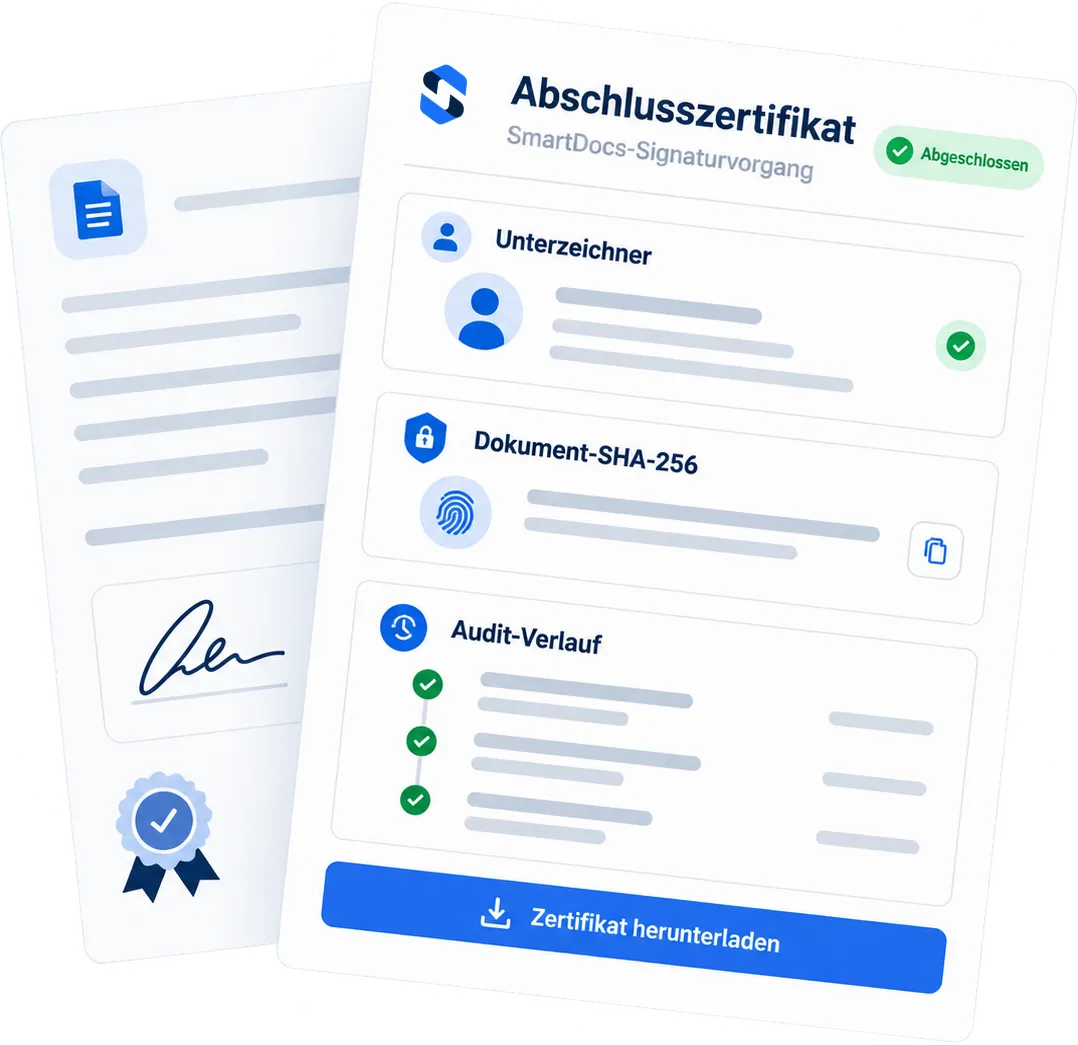
The QES is triggered in the SmartDocs request and bound to the document. The audit trail and completion certificate document the entire process.
Ready for your first QES?
Request the QES for your team. The quote depends on volume and identification method.
A QES used to require a signature card and a card reader. Today, remote signing is the norm: the trust service provider manages the signature creation device, and the signer approves the signature in the browser or on a smartphone. The eIDAS Regulation expressly allows this, as long as a qualified trust service provider manages the signature creation data (Annex II eIDAS).
Pricing
QES with SmartDocs: terms on request
The QES is billed per signature. Volume and identification method determine the price: we will put together a quote that fits your needs.
Billed per signature
Video ident or online ID
In the same workflow as SES and AES
Audit trail and completion certificate for every request
You can check in a few minutes whether a document really carries a qualified signature.
1
In your PDF reader
Adobe Acrobat Reader and other PDF programs show in the signature panel who signed, whether the document has been changed since, and whether the signature is recognized as qualified under eIDAS.
2
With the EU validation tool
The European Commission provides DSS, a freely accessible demo for validating signatures. The validation report states whether the signature counts as qualified.
What matters is the moment of signing: if the qualified certificate was valid then, the signature can still be confirmed as valid after the certificate expires (Art. 32 (1) (b) eIDAS), provided the necessary validation data is preserved. Signature formats such as PAdES embed timestamps and revocation information for this. For very long retention periods, there are qualified preservation services (Art. 34 eIDAS).
Every SmartDocs request also comes with a completion certificate with the audit history and a checksum of the document.
Telling them apart
QES, AES or qualified seal?
Three methods that are often confused. Only one of them replaces a person’s signature.
Comparison of AES, QES and the qualified electronic seal
Criterion
AES
QES
Qualified seal
Who signs
a natural person
a natural person
a legal person, such as a company or public authority
Proof of identity
unique link, for example by SMS code
ID check by a trust service provider
verified organization, qualified seal certificate
Legal effect
higher evidential value, free assessment of evidence
Our guide SES, AES, QES: the differences compares all three signature levels with definitions, evidential value and examples.
FAQ
Frequently asked questions about the QES
The qualified electronic signature (QES) is the highest level of electronic signature under the eIDAS Regulation. It is an advanced electronic signature that is based on a qualified certificate and created with a qualified signature creation device (Art. 3 (12) eIDAS). A qualified trust service provider issues the certificate after an identity check.
Yes. Under Art. 25 (2) of the eIDAS Regulation, the qualified electronic signature has the same legal effect as a handwritten signature. In Germany, it meets the electronic form under § 126a BGB (German Civil Code) and therefore replaces the statutory written form wherever the electronic form is allowed.
Whenever the law requires the statutory written form and does not exclude the electronic form. Important cases are the fixed term of an employment contract (§ 14 (4) TzBfG), residential leases with a fixed term of more than one year (§ 550 BGB), the termination of a residential lease (§ 568 (1) BGB), real estate consumer credit agreements (§ 492 BGB) and electronic employment references (§ 109 (3) GewO).
You identify yourself once with a qualified trust service provider, for example with the online ID function or by video ident. The provider then issues a qualified certificate. Every later signature only needs your approval, usually as a remote signature in the browser or on a smartphone. With SmartDocs, you trigger the QES directly in the signature request.
Yes, through the online ID function: you use it to prove your identity to a trust service provider, which then issues the qualified certificate for remote signing. You do not need a card reader or a signature card; an NFC-capable smartphone with the AusweisApp and your six-digit PIN are enough.
No. After the first identification, the verified identity can be reused for later signatures as long as the certificate is valid. Recurring signers sign considerably faster as a result.
At SmartDocs, the QES is available on request. It is billed per signature; volume and identification method determine the price. You can request a quote via the contact page or in a 30-minute call.
What counts is the time of signing. If the qualified certificate was valid at that moment, the signature can still be confirmed as valid after the certificate expires (Art. 32 (1) (b) eIDAS), provided the validation data such as timestamps and revocation information is preserved.
Open the PDF in Adobe Acrobat Reader and look at the signature panel, or upload the file to DSS, the European Commission’s free validation tool. The EU Trusted List shows whether the issuer is a qualified trust service provider.
For documents with a qualified signature, there is a presumption of authenticity under § 371a (1) ZPO (German Code of Civil Procedure). Anyone disputing the signature must present facts that give rise to serious doubt about its authenticity. For simple and advanced signatures, by contrast, the party relying on the signature has to prove that it is authentic.
Yes. A qualified electronic signature based on a qualified certificate issued in an EU member state is recognized as a QES in all other member states (Art. 25 (3) eIDAS).
No. A QES is always created by a natural person, such as a managing director or an authorized signatory acting on behalf of the company. For organizations, there is the qualified electronic seal, which proves the integrity and origin of a document (Art. 35 (2) eIDAS) but does not replace a signature.
No. § 623 BGB requires the statutory written form for terminations and termination agreements in employment and expressly excludes the electronic form. Even a QES is therefore not enough; it takes paper with a handwritten signature.
Sources and status
Last checked on . All legal provisions have been compared with the official versions. German statutes are linked in German.