SES, AES or QES: the differences and which signature you need
SES, AES and QES are the three levels of electronic signature under the eIDAS Regulation. German sources call them EES, FES and QES. They differ in how reliably the signer is identified, how well the document is protected against changes, and what legal effect the signature has. The good news: for most contracts, the simplest one is enough.
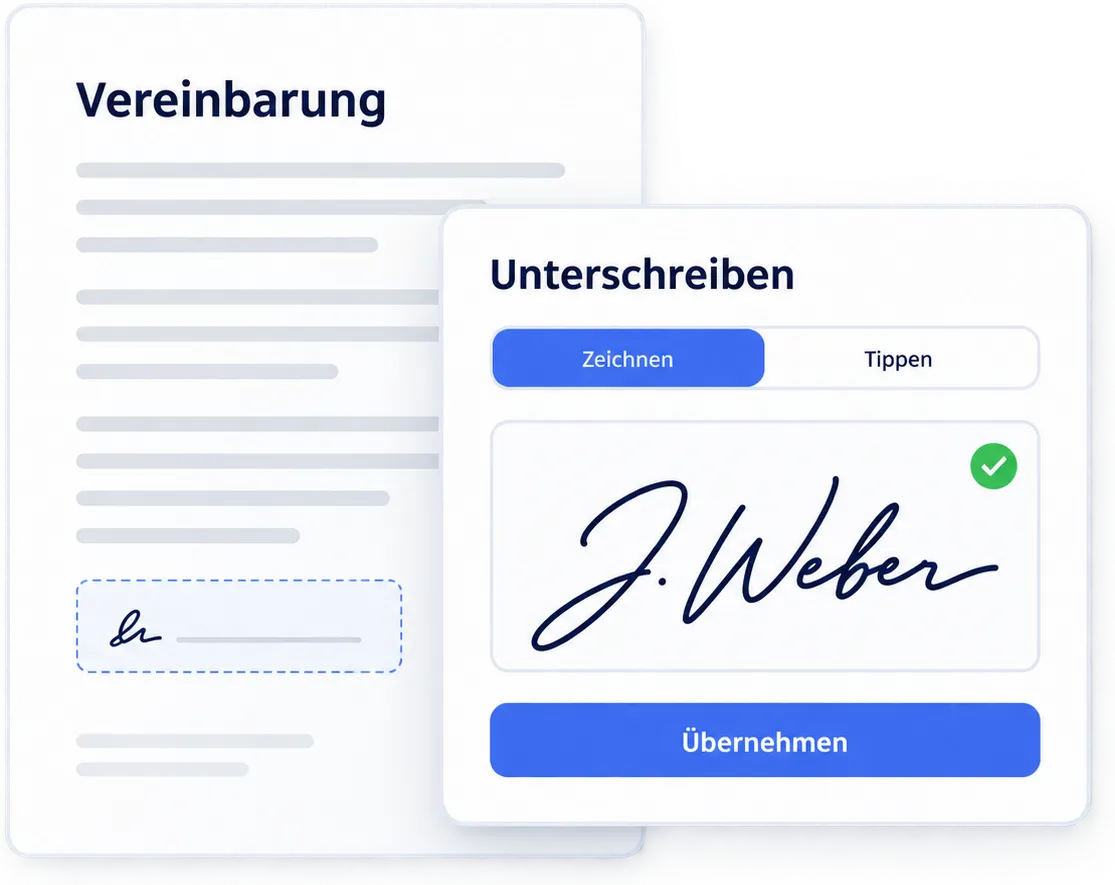
Any electronic signature without minimum technical requirements, such as a click or a signature drawn in the browser. Effective for all contracts with no form requirement and admissible as evidence in court (Art. 25 (1) eIDAS).
AES
Uniquely linked to the signer, and later changes become detectable (Art. 26 eIDAS). Higher evidential value, but it does not meet the statutory written form.
QES
Based on a qualified certificate issued after an ID check. Same legal effect as a handwritten signature (Art. 25 (2) eIDAS), and it replaces the statutory written form in Germany (§ 126a BGB).
Rule of thumb
SES for everyday business, AES for important contracts, QES where the law requires the statutory written form.
Limit
Some declarations only work on paper or before a notary, such as a guarantee given by a private individual (§ 766 BGB) or the termination of employment (§ 623 BGB).
At a glance
The three levels under eIDAS
Each level includes the requirements of the one before. With every level, identity assurance, evidential value and effort increase.
The three levels under eIDASEach level includes the requirements of the one before
SES
Simple electronic signature
Identity
No verification required, usually a confirmed email address
Legal effect
Valid for contracts without a form requirement, admissible as evidence
Art. 3 (10), Art. 25 (1) eIDAS
AES
Advanced electronic signature
Identity
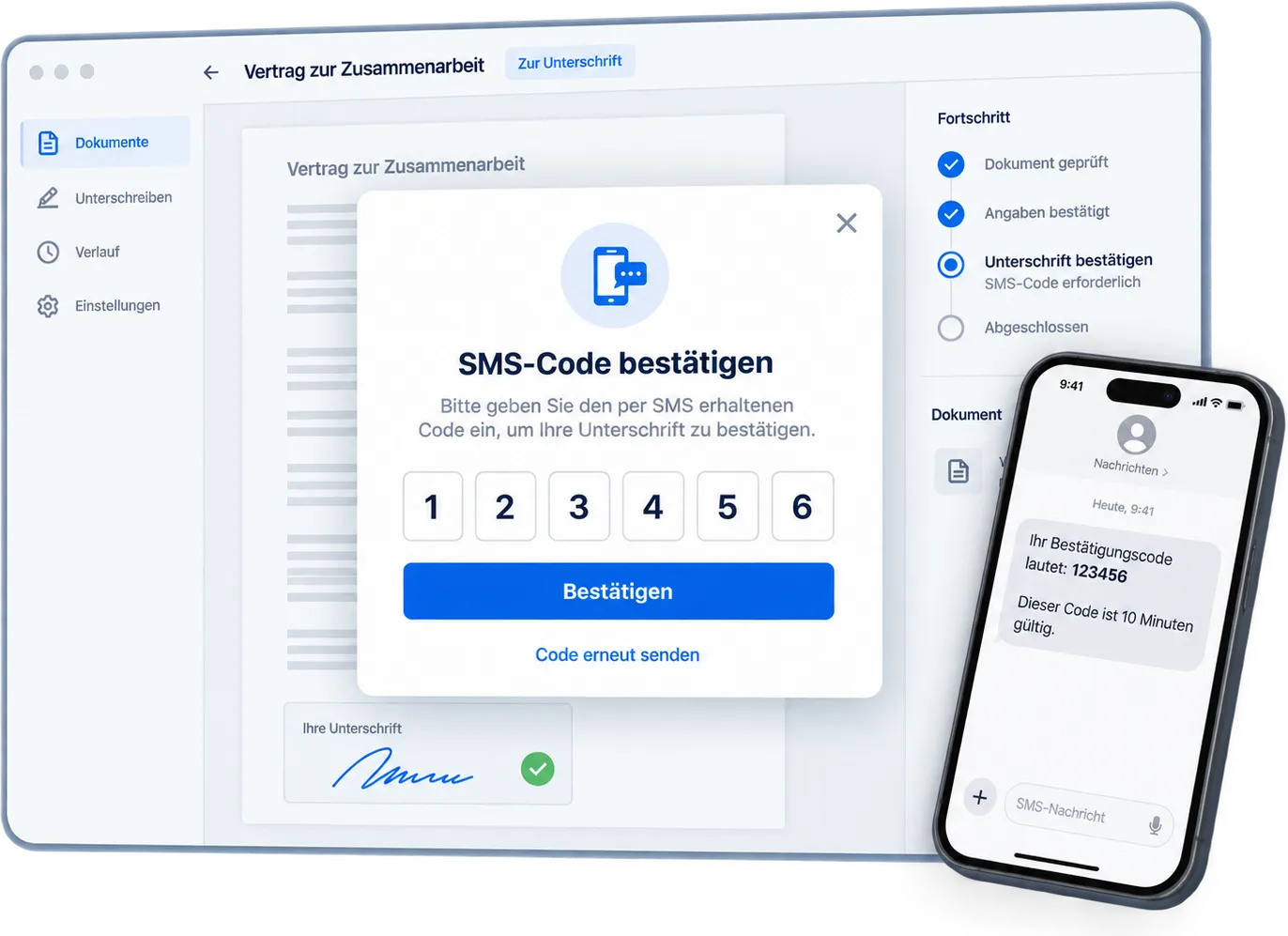
Uniquely linked to the signer, for example via a one-time SMS code
Legal effect
Higher evidential value, later changes are detectable
Art. 26 eIDAS
QES
Qualified electronic signature
Identity
ID check by a qualified trust service provider
Legal effect
Equivalent to a handwritten signature, meets the written form
Art. 25 (2) eIDAS, § 126a BGB
Identity assurance, evidential value and effort increase
Beyond that: For some declarations, German law excludes the electronic form, for example a guarantee given by a private individual (§ 766 BGB) or the termination of employment (§ 623 BGB). They need paper or a notary.
Head to head
The three levels side by side
Definition, identity, evidential value, form requirements and effort: every criterion in one table.
Comparison of the signature levels SES, AES and QES
Criterion
SES Simple electronic signature
AES Advanced electronic signature
QES Qualified electronic signature
Definition
Art. 3 (10) eIDAS
Art. 3 (11), Art. 26 eIDAS
Art. 3 (12) eIDAS
Signer identity
not verified, usually a confirmed email address
uniquely linked, for example by a one-time code sent to the mobile number
ID check by a qualified trust service provider
Protection against changes
not required
changes detectable
changes detectable
Legal effect
admissible evidence
higher evidential value
same as a handwritten signature
In court
free assessment of evidence (§ 286 ZPO)
free assessment of evidence (§ 286 ZPO)
presumption of authenticity (§ 371a ZPO)
Statutory written form
no
no
yes, unless the electronic form is excluded
Text form (§ 126b BGB)
met
met
met
Effort for signers
one click
plus a one-time code
one-time identification, then approval by PIN or app
Under Art. 3 (10) eIDAS, an electronic signature is any data in electronic form which is attached to or logically associated with other data in electronic form and which is used by the signer to sign. There are no minimum technical requirements.
What it looks like
The signer receives a personal link by email, opens the document in the browser and signs with one click or by drawing with a finger. A name typed under an email or an inserted image file of a signature are technically simple electronic signatures too, just very weak ones.
Legal effect
An electronic signature may not be denied legal effect solely because it is in electronic form (Art. 25 (1) eIDAS). Since most contracts in Germany have no form requirement, the SES covers the bulk of everyday business. Courts freely assess its evidential value (§ 286 ZPO, German Code of Civil Procedure): the better the process is documented, for example by an audit trail with email delivery, timestamps and a checksum of the document, the stronger the evidence.
Typical documents
Quotes and order confirmations, purchase orders, non-disclosure agreements (NDAs), internal approvals and minutes. Since 2025 also commercial leases and temporary agency work contracts, for which the law now only requires text form.
Limit
If someone denies having signed personally, the party relying on the signature must prove that they did. The SES never meets a statutory written form.
How the SES works in SmartDocs
Personal link by email
The signer opens the document in the browser, without an app and without an account.
Draw or type
The signature is drawn with a finger or mouse, or typed as a name.
Fully documented
Sending, opening and signing are recorded with timestamps in the audit trail.
An AES is an electronic signature that meets the four requirements of Art. 26 eIDAS.
1 It is uniquely linked to the signer.
2 It is capable of identifying the signer.
3 It is created using signature creation data that the signer can, with a high level of confidence, use under their sole control.
4 It is linked to the signed data in such a way that any subsequent change is detectable.
What it looks like
In practice, the link to the person is established through a second factor. At SmartDocs, this is a one-time code by SMS sent to the mobile number on file: only someone with access to that phone can sign. The sealed document reveals any later change.
Legal effect
The AES is also subject to the free assessment of evidence, but it is much harder to challenge than an SES, because the signer’s identity and the integrity of the document are technically secured. It does not meet a statutory written form.
Typical documents
Permanent employment contracts, open-ended leases, insurance applications, framework and service agreements: anything with high value, a long term or potential for dispute.
Limit
If the law requires the statutory written form, the AES does not help either.
How the AES works in SmartDocs
Two factors instead of one
Access to the inbox alone is no longer enough. The signer’s mobile phone is needed as well.
Recorded in the audit trail
The successful code confirmation is logged as its own event in the chain of evidence, with a timestamp.
No extra work for you
You choose the level when you create the request. The other party does not need to install anything.
The QES is an advanced electronic signature that is created by a qualified electronic signature creation device and based on a qualified certificate for electronic signatures (Art. 3 (12) eIDAS). The certificate is issued by a qualified trust service provider that is listed on the EU Trusted List and, in Germany, supervised by the Federal Network Agency (Bundesnetzagentur).
What it looks like
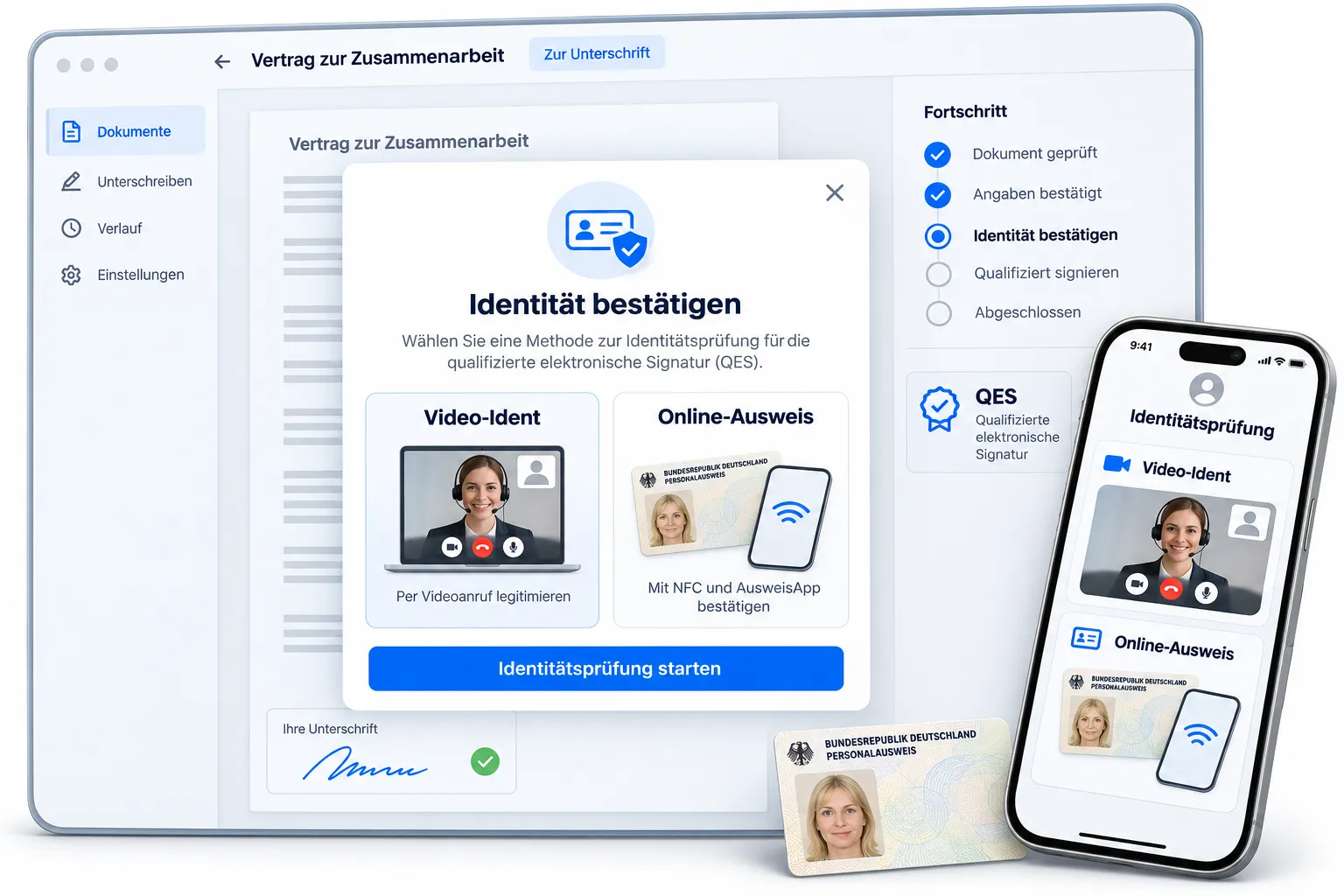
The signer proves their identity once, for example by video identification or with the eID function of the German national ID card. After that, the signature is usually triggered as a remote signature: the signing key is stored securely with the trust service provider, and the signer approves by PIN, one-time code or app.
Legal effect
A QES has the same legal effect as a handwritten signature (Art. 25 (2) eIDAS) and is recognized as a QES in all EU member states (Art. 25 (3) eIDAS). In Germany, it replaces the statutory written form unless the law excludes the electronic form (§ 126 (3), § 126a BGB). For contracts, both parties must sign an identical document with a qualified signature (§ 126a (2) BGB). In court, there is a presumption of authenticity that can only be rebutted by facts that give rise to serious doubt (§ 371a (1) ZPO).
Typical documents
Fixed-term clauses in employment contracts (§ 14 (4) TzBfG), residential leases with a fixed term of more than one year (§ 550 BGB), real estate consumer credit agreements (§ 492 BGB) and electronic employment references if the employee consents (§ 109 (3) GewO).
Limit
Transactions that must be notarized remain closed to the QES, as do declarations for which the law expressly excludes the electronic form.
How the QES works in SmartDocs
Video ident or online ID
The identity is checked once, for example by video call or with the online ID function.
In the same request
The QES runs in the same workflow as SES and AES, without switching tools.
Identify once
The verified identity can be reused for later signatures as long as the certificate is valid.
Decision guide
Which level does your document need?
Choose your document: the level finder shows the form requirement, the minimum level and our recommendation, each with its legal basis.
Which document do you want to have signed?
Your document is not listed?
1If the law requires paper or a notary, it cannot be done electronically.
2If it requires the statutory written form, you need the QES.
3Otherwise the SES is enough. For high value, a long term or a risk of dispute, we recommend the AES.
The level finder shows the form requirement, the legal minimum level and our recommendation, with the legal basis.
Frequently searched
Guidance, not legal advice for your individual case. When in doubt, choose the higher level.
The rule of thumb in three questions
For documents that are not on the list, in exactly this order:
1
Does the law require paper or a notary?
For example, for a guarantee given by a private individual, the termination of employment or a real estate purchase. Then it cannot be done electronically.
2
Does the law require the statutory written form?
Then use the QES. It is the only electronic form that replaces the statutory written form.
3
Is a lot of money, a long term or a potential dispute involved?
Then use the AES. For everything else, the SES is enough.
What changed for choosing a level in 2025 and 2026
German lawmakers keep lowering the form for more documents from the statutory written form to text form. Where only paper or a QES used to count, the simple signature is now often enough.
Fourth Bureaucracy Relief Act
Written form Text form
Commercial leases of more than one year (§ 578 (1) BGB)
Temporary agency work contracts (§ 12 (1) AÜG)
Statement of employment terms (§ 2 (1) NachwG), except in the sectors under § 2a SchwarzArbG
Ending employment at the standard retirement age (§ 41 SGB VI)
Since then, the SES has been enough for these documents.
New since then: employment references may be issued electronically with the employee’s consent, by QES (§ 109 (3) GewO).
Pre-selected options such as boxes that are already ticked are not enough for consent
From this date, the SES is enough.
Unchanged: real estate consumer credit agreements still require the statutory written form, meaning paper or a QES.
EU Digital Identity Wallet
QES per signature QES free of charge
All EU member states are to offer their citizens a European Digital Identity Wallet
Natural persons are to be able to create qualified signatures free of charge for non-professional purposes (Art. 5a (5) (g) eIDAS)
For private contracts that require the statutory written form, the hurdle to a QES drops significantly.
In all honesty
What you cannot sign electronically at all
For some documents, the law requires notarization or expressly requires paper. Not even the best e-signature changes that.
Real estate purchase contracts (notarization, § 311b BGB)
Wills and inheritance contracts
Marriage contracts
Formation of a GmbH and transfers of shares
Termination of employment and termination agreements (§ 623 BGB, written form with the electronic form excluded)
Guarantees given by private individuals (§ 766 BGB, written form with the electronic form excluded)
Everything else, which is the vast majority of business documents, you can conclude digitally and in a legally binding way with SmartDocs.
Setting the record straight
Four common misconceptions
Four assumptions that refuse to go away, and what actually applies.
Misconception
A scanned signature is a secure electronic signature.
What applies
An inserted image is technically a simple electronic signature, but it can be copied at will, does not verifiably link the signature to anyone and does not protect the document against changes. It never meets the statutory written form. For this reason, the LAG Berlin-Brandenburg (Regional Labor Court) held a fixed term with a scanned signature to be invalid (23 Sa 1133/21).
Misconception
The AES replaces the statutory written form.
What applies
In Germany, only the QES replaces the statutory written form (§ 126a BGB). The AES is still the right choice for most important contracts, because these have no form requirement.
Misconception
Every important contract needs a QES.
What applies
Most contracts have no form requirement, and since 2025 even text form has been enough in several cases. The QES is meant for cases where the law requires the statutory written form, not for every high amount in dispute.
Misconception
Digital signature and electronic signature are the same thing.
What applies
In everyday use, the two terms are interchangeable, and the eIDAS Regulation only speaks of electronic signatures. Technically, a digital signature means a cryptographic method with a key pair, on which AES and QES are usually based. Learn more in our article on the digital signature.
With SmartDocs
All three levels, one platform
You choose the level for each signature request with a single click. The NDA goes out with SES in seconds, and the fixed-term employment contract runs through the QES.
SES
In every plan
Including the free plan, for all everyday documents with no form requirement.
AES
From the Pro plan
With an SMS code to the mobile number, including 15 SMS per seat per month.
QES
On request
As an add-on per signature, for documents that require the statutory written form.
Tamper-evident audit trail for every request
Completion certificate with a checksum of the document
The three levels of the eIDAS Regulation differ in how reliably the signer is identified and what legal effect the signature has. The simple electronic signature (SES) has no minimum technical requirements. The advanced electronic signature (AES) is uniquely linked to the signer and makes changes detectable (Art. 26 eIDAS). The qualified electronic signature (QES) is additionally based on a qualified certificate issued after an ID check and is equivalent to a handwritten signature (Art. 25 (2) eIDAS).
Rule of thumb: contracts with no form requirement, such as quotes, NDAs or orders, work with the simple signature (SES). Where evidence matters more, for example for permanent employment contracts or leases, the advanced signature (AES) is recommended. You only need the qualified signature (QES) when the law requires the statutory written form.
Yes. An electronic signature may not be denied legal effect solely because it is in electronic form (Art. 25 (1) eIDAS). For all contracts with no form requirement, which is the vast majority, the SES is effective and admissible as evidence in court. It is not enough for the statutory written form.
The advanced signature is uniquely linked to the signer, and any later changes to the document are detectable. At SmartDocs, a one-time code is also sent by SMS to the stored mobile number, on top of the personal link.
Whenever the law requires the statutory written form and does not exclude the electronic form (§ 126 (3), § 126a BGB). Important examples are the fixed term of an employment contract (§ 14 (4) TzBfG), residential leases with a fixed term of more than one year (§ 550 BGB), real estate consumer credit agreements (§ 492 BGB) and electronic employment references (§ 109 (3) GewO).
For a permanent employment contract, yes, because it has no form requirement. If the contract is to be fixed-term, the fixed-term clause requires the statutory written form under § 14 (4) TzBfG, meaning paper or a QES. Without it, the employment relationship is deemed permanent (§ 16 TzBfG).
Technically, an inserted image of a signature is a simple electronic signature, but a weak one: it can be copied at will and does not protect the document against changes. It does not meet the statutory written form. For this reason, the LAG Berlin-Brandenburg (Regional Labor Court) held a fixed term with a scanned signature to be invalid (judgment of March 16, 2022, 23 Sa 1133/21).
Not as a private individual. § 766 BGB requires the statutory written form for the declaration of guarantee and expressly excludes the electronic form, so even a QES is not enough. For merchants, a guarantee has no form requirement (§ 350 HGB, German Commercial Code).
Statutory written form (Schriftform, § 126 BGB) requires a handwritten signature or, as the electronic form, a QES. Text form (Textform, § 126b BGB) only requires a legible declaration on a durable medium that names the person making it; no signature is needed. Since 2025, text form has been sufficient in several cases, such as commercial leases of more than one year.
Yes. A qualified electronic signature based on a qualified certificate issued in an EU member state is recognized as a QES in all other member states (Art. 25 (3) eIDAS).
The QES is usually billed per signature, because it includes identity verification by a trust service provider. With SmartDocs, the QES is available on request; SES and AES are included in the plan.
By the end of 2026, all EU member states are to offer their citizens a European Digital Identity Wallet. It is intended to let natural persons create qualified signatures free of charge for non-professional purposes (Art. 5a (5) (g) eIDAS as amended by Regulation (EU) 2024/1183).
Yes. You choose the signature level per signature request. That way you send out an NDA with SES in seconds and use QES for the fixed-term employment contract, both from the same platform.
Sources and status
Last checked on . All legal provisions have been compared with the official versions. German statutes are linked in German.